
- Learn what to expect when visiting the Emergency Department Learn More
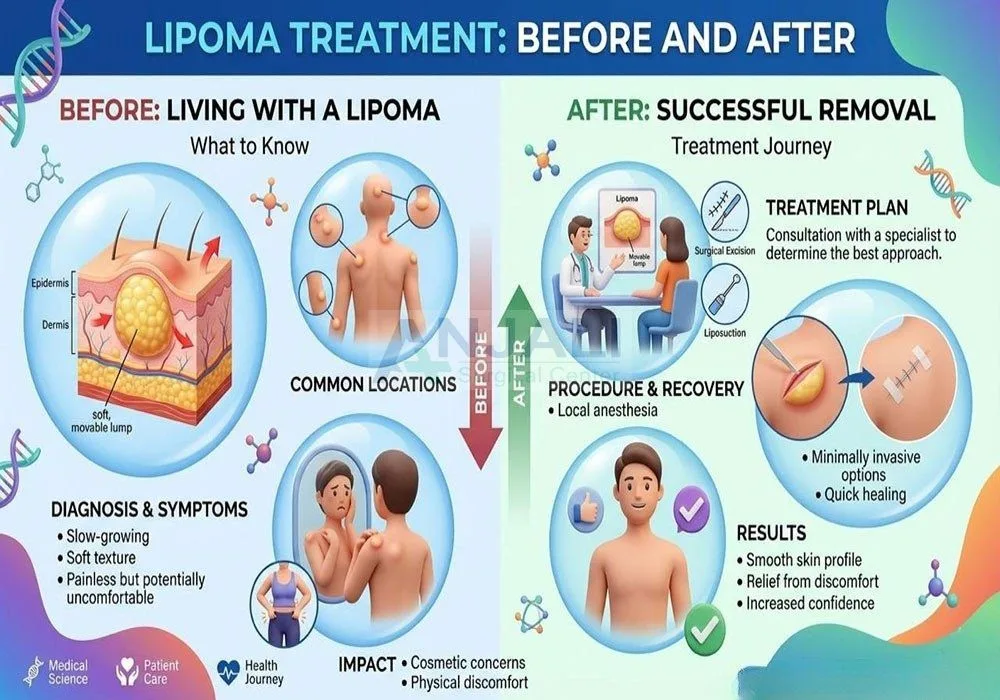
A lipoma is a benign (non-cancerous) growth of fat cells that develops under the skin. It usually appears as a soft, round, or oval lump that moves easily when touched. Lipomas grow slowly and are generally painless, which is why many people notice them only when they become visible or slightly larger.
These fatty lumps can occur anywhere in the body where fat cells are present, but they are most commonly found on the neck, shoulders, back, arms, thighs, or abdomen. Lipomas are usually harmless and do not spread to other parts of the body.
Although lipomas are typically not dangerous, some people may choose to have them removed if they become large, uncomfortable, or cosmetically noticeable. Surgical removal is the most common and effective treatment for lipomas.
Lipomas develop when fat cells grow and multiply in a localized area under the skin. The exact cause is not always clear, but several factors may increase the likelihood of developing a lipoma.
There are several types of lipomas depending on the tissues involved and their location.
1. Conventional Lipoma
This is the most common type and consists mainly of mature fat cells. It usually appears as a soft lump under the skin.
2. Fibrolipoma
This type contains both fat cells and fibrous tissue, making it slightly firmer than a typical lipoma.
3. Angiolipoma
Angiolipomas contain small blood vessels and may sometimes be painful.
4. Intramuscular Lipoma
This type develops deeper within the muscles and may require more detailed evaluation before removal.
5. Spindle Cell Lipoma
A rare form of lipoma that contains specialized spindle-shaped cells and usually occurs in the neck, shoulders, or back.
Lipomas usually cause very few symptoms and are often discovered accidentally. However, some common features include:
If a lump grows rapidly, becomes painful, or feels firm and fixed, medical evaluation is important to rule out other conditions.
The treatment of breast diseases depends on the specific condition, its severity, and whether it is benign (non-cancerous) or malignant (cancerous). Here are some general approaches to the treatment of various breast diseases:
1. Breast Cancer:
• Surgery : Surgical procedures, such as lumpectomy (removing the tumor) or mastectomy (removing the breast), are often performed to treat breast cancer. Lymph node removal may also be necessary.
• Radiation Therapy : Radiation is used to destroy cancer cells or shrink tumors after surgery.
• Chemotherapy : Chemotherapy drugs are used to target and kill cancer cells throughout the body.
• Hormone Therapy : For hormone receptor-positive breast cancer, hormone-blocking medications are used to slow or stop cancer growth.
• Targeted Therapy : Some breast cancers can be treated with targeted therapies that focus on specific molecules involved in cancer growth.
• Immunotherapy : This treatment helps the immune system identify and attack cancer cells.
2. Benign Breast Conditions:
• Fibrocystic Breast Changes: No treatment may be needed unless there is pain or discomfort. Pain relief measures and lifestyle changes may help.
• Breast Cysts : If a cyst is causing discomfort or concern, it can be drained using a fine needle aspiration.
• Fibroadenomas : These benign tumors may be left untreated if they don’t cause symptoms. If necessary, they can be removed surgically.
• Mastitis : Antibiotics are often prescribed for bacterial infections. Continued breastfeeding or pumping is encouraged.
• Benign Breast Pain : Management may involve lifestyle changes, pain relief medications, or hormonal treatments.
3. Other Breast Conditions:
• Treatment for Paget’s disease of the breast or other skin conditions may involve surgery, often in conjunction with other breast cancer treatments.
• Nipple discharge is evaluated to determine the underlying cause. Treatment depends on the diagnosis.
We always take care of your smile
+91 9001913353